The History of Mobile Money in Ghana

In 2025, Ghanaians moved GH¢4.54 trillion through mobile wallets. That is more than half the country’s GDP, conducted entirely over phone networks — 2.8 times more value than all traditional payment channels combined. Over 74 million accounts registered. More than half of all Ghanaian adults rely on a digital wallet as their primary financial tool.
It all started in 2009 with 20,000 people and a service most Ghanaians thought was too risky to trust. This is how mobile money went from a novelty to the backbone of Ghana’s financial system — and why it matters for everyone selling, buying, or building a business in Ghana today.
Ghana Before Mobile Money
In 2008, Ghana had a financial inclusion problem that was quietly shaping everything. Only about 29 percent of Ghanaian adults held any kind of formal bank account. The rest of the country depended entirely on cash.
For most Ghanaians, the bank was not a realistic option. Rural communities were often hours from the nearest branch. Opening an account required documentation many people did not have. Minimum balance requirements excluded the low-income majority. Even in Accra and Kumasi, the banking system served a thin slice of the population — mostly formal sector employees and business owners.
Sending money across the country meant physically carrying cash or finding someone travelling in that direction. Susu collectors — informal savings agents who visited customers daily to collect small amounts — were the financial infrastructure for millions of households. Remittances from Ghanaians abroad arrived through Western Union or MoneyGram outlets, often with fees that ate 10 to 15 percent of the value.
For the 71 percent of Ghanaians without a bank account in 2008, every financial transaction carried the risk of loss, theft, or fraud — because it happened in cash.
This was the problem MTN set out to solve.
2009: The Launch
On July 21, 2009, MTN Ghana officially launched Mobile Money (MoMo) in a ceremony presided over by Bank of Ghana Governor Paul Acquah and MTN Ghana’s first General Manager Bruno Akpaka. MTN had been laying the groundwork for months — recruiting and training agents, building the platform, working with the Bank of Ghana to establish a regulatory framework for an entirely new type of financial service.
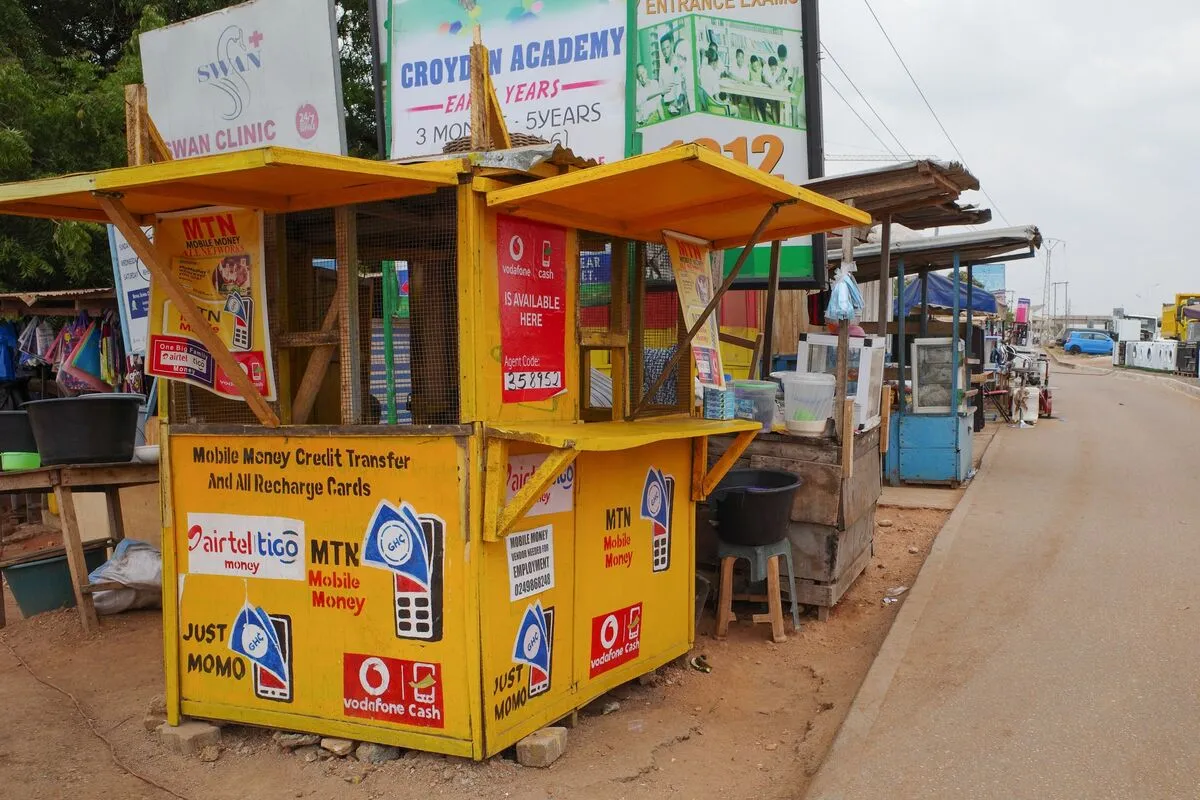
The proposition was simple: store money on your phone, send it to anyone with a phone number, and cash out at any agent. Agents were the key — they were the human interface between digital money and the cash economy. A shopkeeper, a pharmacy, a kiosk could become a financial access point. You handed over cash, they loaded it onto your phone number as e-money. The person you sent it to could walk to any agent and do the reverse.
By October 2009, MoMo had registered approximately 20,000 subscribers. To put that in context: Ghana’s population was roughly 24 million. A fraction of a fraction. Most Ghanaians were sceptical — understandably so. They had never trusted a service that held their money without a physical branch they could walk into.
The early use case was almost entirely remittances. Parents in Accra sending money home to children in Tamale. Workers in the city supporting family in rural regions. It was not yet a payment system — it was a transfer system. But that was enough to get started.
2010–2014: Early Growth and Competition
In 2010, Airtel Ghana entered the market with Airtel Money. Tigo followed in 2012 with Tigo Cash. Competition helped push awareness, but adoption remained slow. The agent network was thin outside major cities. Network reliability was inconsistent. And a deeply ingrained distrust of non-bank financial services was hard to overcome.
Building the agent network
The agent network was both the biggest advantage and the biggest challenge of mobile money in this period. Agents needed sufficient float — physical cash and e-float balanced on their accounts — to serve customers. When an agent ran out of cash, customers could not withdraw. When an agent ran out of e-float, customers could not deposit. Managing this liquidity across thousands of agents in cities, towns, and rural areas was an ongoing operational challenge.
By 2012, Ghana had approximately 5,900 active mobile money agents. That number would eventually grow to over 600,000 — a 100-fold increase — but in this period the network was still thin, particularly outside the Greater Accra and Ashanti regions.
The regulatory groundwork
The Bank of Ghana was laying quiet groundwork in this period. In 2012, it issued Agent Guidelines that created clearer rules for agent networks. In 2015, it would issue the landmark E-Money Issuer Guidelines — but even before that formal framework, the Bank of Ghana was working actively with telecom operators to develop a regulatory approach that would balance access with safety.
By 2014, financial inclusion in Ghana stood at 41 percent — up from 29 percent in 2008, but still leaving the majority of adults without formal financial services. The mobile money sector had made progress, but the real inflection point was still ahead.
41% — Ghanaian adults with financial accounts in 2014 (World Bank Findex)
2015–2017: Going Mainstream
Three things happened between 2015 and 2017 that changed the trajectory of mobile money in Ghana permanently.
Vodafone Cash enters the market
In 2015, Vodafone Ghana launched Vodafone Cash, entering a market where MTN had been dominant for six years. The addition of a fourth provider (alongside Airtel Money and Tigo Cash) accelerated competition and pushed all operators to improve their services, reduce friction, and expand agent coverage.
The DEMI framework unlocks growth
Also in 2015, the Bank of Ghana issued its Dedicated Electronic Money Issuer (DEMI) guidelines — a licensing framework that allowed mobile money providers to operate as financial institutions in their own right, without requiring users to link every mobile wallet to a bank account.
This was a quiet but significant unlock. Before the DEMI framework, there was regulatory ambiguity about what mobile money accounts actually were and who was ultimately responsible for the funds. The new framework gave telecom operators a clear mandate to issue e-money and hold customer funds, with the Bank of Ghana as the regulator. It reduced friction for customers and gave operators the confidence to invest more heavily in infrastructure.
Financial inclusion jumps to 58 percent
The 2017 World Bank Global Findex Report recorded one of the most dramatic financial inclusion jumps in any country: Ghana went from 41 percent to 58 percent adult account ownership between 2014 and 2017. Mobile money was the primary driver. Millions of Ghanaians who had never held a bank account now had a mobile money wallet they used regularly.
58% — Ghanaian adults with financial accounts in 2017, up from 41% in 2014
In 2017, Airtel and Tigo merged to form AirtelTigo, consolidating the third and fourth mobile money providers into a single entity. The same year, Ghana became one of the first countries in Africa to launch a cross-network mobile money interoperability system — allowing transfers between different telecom providers for the first time.
2018–2019: Interoperability and the Legal Framework
In 2018, the interoperable mobile money system built on GhIPSS (Ghana Interbank Payment and Settlement Systems) became fully operational. This was a watershed moment.
Before interoperability, an MTN MoMo user could easily send money to another MTN user, but cross-network transfers were cumbersome and often required going through agent cash-outs. The result was that users concentrated on whichever network their contacts used — creating a fragmented market that limited adoption. After interoperability, any mobile money wallet could send to any other wallet, regardless of network. The system became far more useful.
Interoperability turned Ghana’s fragmented mobile money market into a unified payment rail — and changed how the whole economy moved money.
In 2019, the Payment Systems and Services Act (Act 987) was enacted — Ghana’s first comprehensive legal framework for payment systems. The Act gave mobile money a clear legal status, set out licensing requirements for payment service providers, and gave the Bank of Ghana explicit enforcement powers. Operating an unlicensed payment service became a criminal offence.
Also in 2019, mobile phones officially became the most widely used payment medium in Ghana — surpassing cash for the first time in the country’s history. The payment system that had launched with 20,000 users a decade earlier had become the country’s default financial infrastructure.
2020–2021: COVID-19 Accelerates Everything
When COVID-19 reached Ghana in March 2020, the response accelerated digital payments in ways that might otherwise have taken years.
The government and the Bank of Ghana acted quickly. They waived transaction fees for low-value mobile money transfers to reduce cash handling and limit virus transmission. Businesses that had been hesitant about mobile payments had no choice but to adopt them. Markets, pharmacies, food vendors, and service businesses all integrated mobile money payments rapidly.
The numbers told the story. In February 2020, Ghana had 32.7 million registered mobile money accounts. By February 2021, that had grown to 40.9 million — a 25 percent increase in a single year, driven by the pandemic forcing both individuals and businesses onto digital platforms.
40.9M — Registered mobile money accounts in Ghana by February 2021
By 2021, active mobile money accounts (22 million) outnumbered traditional bank accounts (18 million) for the first time. The financial system that the formal banking sector had spent decades building had been surpassed — in active user count — by a network that was less than 12 years old.
2022–2023: The E-Levy Setback
In late 2021, Ghana’s government, facing a deteriorating fiscal position and rising debt, proposed an e-levy — a tax on electronic transactions. The original proposal: 1.75 percent on all mobile money transfers above GHS 100 per day.
The reaction was swift and fierce. Civil society groups, fintech associations, business organisations, and opposition parliamentarians argued that the tax would undo years of financial inclusion gains. The core equity argument was stark: for households in the lowest income quintile, the e-levy would represent approximately 4 percent of their reported monthly earnings. For the highest income quintile, less than 1 percent. A tax designed to raise revenue was structured in a way that hit the poorest hardest.
After months of parliamentary debate, a revised rate of 1.5 percent was passed in March 2022. The e-levy went live in May 2022.
The immediate impact
The numbers were damning. Mobile money transaction volumes dropped by approximately 25 percent immediately. Cash-out withdrawals — people withdrawing their money and returning to physical cash — surged 61 percent in value. Revenue from the levy came in 20 percent below pre-levy transaction levels after nine months. The tax had triggered exactly the behaviour its critics had warned about: people were abandoning digital money rather than pay.
The e-levy became a global case study in how a poorly designed digital transaction tax can reverse years of financial inclusion progress in months.
By January 2023, the government reduced the rate to 1.0 percent, acknowledging that the original rate was suppressing adoption. But the damage was measurable even at the lower rate. The e-levy had achieved only 12 percent of its original revenue target — raising approximately US$129 million annually against a projection of GH¢6.96 billion — while visibly slowing the adoption of digital payments among the poorest Ghanaians.
On April 2, 2025, the e-levy was abolished entirely. Transaction volumes surged 26.2 percent in the months following the repeal. It had taken three years to undo the damage.
Growth despite the headwinds
Despite the levy’s disruption, the structural shift toward mobile money continued. Total mobile money transaction value grew from GH¢1.07 trillion in 2022 to GH¢1.912 trillion in 2023 — a 78.7 percent increase year-on-year. The underlying economy was still digitalising, even if at a slower pace than it would have without the tax.
2024–2025: Record Growth
The years following the e-levy’s reduction — and ultimately its abolition — produced the strongest growth figures in Ghana’s mobile money history.
2024 — breaking records
In 2024, total mobile money transaction value reached GH¢3.01 trillion — a 56.8 percent increase over 2023. Ghanaians conducted 8.1 billion individual transactions, up 18.9 percent from 2023. Registered accounts climbed from 66.9 million at the start of the year to 74.1 million by February 2025.
GH¢3.01T — Mobile money transaction value in Ghana, 2024 (+56.8% year-on-year)
GhIPSS Instant Pay (GIP) — the real-time rail underpinning mobile money interoperability — processed GH¢47.5 billion in 2024, up 233 percent year-on-year. The payment infrastructure that the Bank of Ghana and GhIPSS had been quietly building for over a decade was now one of the most active payment rails in sub-Saharan Africa.
2025 — the e-levy is gone, growth accelerates
When the e-levy was abolished on April 2, 2025, the response was immediate. Withdrawal and transfer volumes surged 26.2 percent in the months that followed. Businesses and individuals who had drifted back toward cash returned to digital payments. The suppressed demand that had been building for three years was finally released.
By the end of 2025, total mobile money transaction value reached GH¢4.54 trillion — a 51 percent increase over 2024. Monthly transaction value peaked at GH¢518.4 billion in December 2025. Mobile money handled 2.8 times more value than all traditional payment channels combined.
GH¢4.54T — Mobile money transaction value in Ghana, 2025 (+51% year-on-year)
Ghana retains #1 in the world
In 2025, GSMA published its updated Global Mobile Money Regulatory Index. Ghana retained the top ranking — improving its score from 95.06 percent (2024) to 96.10 percent, with perfect scores in transparency and disclosure, authorisation processes, and consumer protection. No other country in the world has held the top position for two consecutive years.
#1 — Ghana’s ranking in the 2025 GSMA Global Mobile Money Regulatory Index (96.10%)
Telecel and the market reshuffle
In February 2023, Telecel Group completed its acquisition of Vodafone Ghana. By February 2024, the rebranding was complete: Vodafone Ghana became Telecel Ghana, and Vodafone Cash became Telecel Cash. The competitive structure of Ghana’s mobile money market remained largely unchanged — MTN MoMo still holds approximately 90 percent of the market by active wallets — but the rebranding reflected a broader global consolidation of telecoms infrastructure in emerging markets. In April 2026, MTN completed the separation of its Ghana mobile money business into a standalone fintech entity, deepening its focus on financial services beyond telecoms.
Digital credit takes off
By 2024, more than 150 digital lending applications were operating in Ghana, most of them using mobile money transaction histories as the primary source of creditworthiness data. AI-powered credit scoring models analyse years of mobile money usage to predict repayment behaviour — the same data that for years was only used to send and receive money is now being used to unlock credit for people who would otherwise qualify for nothing. Approximately USD 115 million in venture capital had flowed into Ghanaian fintech startups. In November 2025, the Bank of Ghana introduced formal digital credit licensing requirements — a sign that the sector had grown large enough to demand regulatory structure.
Ghana vs the World
Ghana is not just a regional mobile money success story — it is a global one. Here is how Ghana compares to the rest of the world.
- 59.7% of adults in Ghana rely on digital wallets for payments, transfers, and savings — compared to a sub-Saharan Africa average of 40%.
- #1 globally in both the 2024 and 2025 GSMA Mobile Money Regulatory Index — the only country to hold the top position in consecutive years. 2025 score: 96.10%.
- Fastest growth in sub-Saharan Africa in 2023: Ghana and Côte d’Ivoire outpaced East Africa — historically the continent’s strongest mobile money region — by 12 percentage points.
- 96% financial service access rate, exceeding Ghana’s own 85% national target, with mobile money as the primary driver.
- Mobile money accounts surpassed bank accounts for the first time in 2021 — and the gap has widened every year since. As of 2025, Ghana has 74.1 million registered mobile money accounts against roughly 20 million traditional bank accounts.
For context, Kenya’s M-Pesa — the most celebrated mobile money service in the world — launched in 2007 and took approximately seven years to reach widespread mainstream adoption. Ghana’s system, starting two years later, has achieved comparable penetration in a market that lacks Kenya’s relative geographic compactness and urban density. That is a significant achievement.
What Comes Next
Ghana’s mobile money story is not close to finished. Several developments are reshaping the market right now.
Merchant payments — the next frontier
Fewer than 30 percent of Ghanaian SMEs consistently use digital channels for sales and invoicing. Merchant payment adoption — the ability for any shop, market stall, or service business to accept mobile money payments digitally — is the next major growth area. As more businesses set up online shops in Ghana, mobile money will transition from a remittance and P2P transfer tool into the default payment mechanism for commerce.
Digital credit and financial services
The expansion of mobile money into credit, insurance, and savings is accelerating. The same phone that holds your mobile wallet will increasingly be the device through which you access loans, save for retirement, and pay premiums. The Bank of Ghana’s November 2025 digital credit licensing requirements signal that this sector has matured enough for formal oversight.
Cross-border remittances
Remittances are Ghana’s third largest source of foreign exchange. The Bank of Ghana approved 14 inbound remittance services in 2024 — double the count from 2023 — reflecting growing demand to connect Ghana’s mobile money infrastructure with diaspora remittance corridors. The ability to receive international transfers directly into a mobile wallet, without touching a bank, will matter enormously for rural and unbanked households.
The infrastructure keeps improving
GhIPSS Instant Pay is becoming the real-time backbone for the entire payment economy. The 233 percent growth in 2024 reflects not just more usage but better infrastructure — faster settlement, higher limits, and broader acceptance by banks and payment platforms. Combined with expanding 4G and 5G coverage, the technical infrastructure for mobile money is stronger than it has ever been.
If you are building a business in Ghana today, mobile money is not a feature — it is the foundation. Whether you are running a market stall or an online store, the customers who will buy from you already have a mobile wallet in their pocket. The question is whether your business is set up to receive it.
Frequently asked questions
When did mobile money start in Ghana?
Mobile money in Ghana launched on July 21, 2009, when MTN Ghana officially introduced MoMo in a ceremony presided over by Bank of Ghana Governor Paul Acquah. By October 2009, the service had registered approximately 20,000 subscribers. Airtel Ghana followed in 2010 and Tigo in 2012, making Ghana one of the earliest multi-provider mobile money markets in Africa.
Who launched mobile money in Ghana?
MTN Ghana launched the country’s first mobile money service — MTN Mobile Money (MoMo) — on July 21, 2009. Airtel Ghana followed in 2010, Tigo Cash in 2012, and Vodafone Cash in 2015. Today the main providers are MTN MoMo, Telecel Cash (formerly Vodafone Cash), and AirtelTigo Money, with MTN holding approximately 90% of the market.
How many people use mobile money in Ghana?
As of February 2025, Ghana had 74.1 million registered mobile money accounts. In 2025, Ghanaians moved GH¢4.54 trillion through mobile money — up from GH¢3.01 trillion in 2024 — conducting roughly 778 million transactions per month. Approximately 59.7% of Ghanaian adults rely on digital wallets for payments, transfers, and savings, well above the sub-Saharan Africa average of 40%.
What is MTN MoMo's market share in Ghana?
MTN MoMo holds approximately 90% of Ghana’s mobile money market by active wallets, with over 20 million active users. The remaining share is split between Telecel Cash (formerly Vodafone Cash) and AirtelTigo Money. MTN’s dominance stems from its early mover advantage (2009 launch), largest agent network, and widest geographic coverage across Ghana.
What was the e-levy and what happened to it?
Ghana’s e-levy was a tax on electronic transactions introduced in May 2022 at a rate of 1.5% on transfers above GHS 100 per day. It was highly controversial — civil society groups argued it would reverse financial inclusion gains and disproportionately burden low-income users. Transaction volumes dropped approximately 25% immediately after implementation and cash-out withdrawals surged 61%. The rate was cut to 1.0% in January 2023 and the levy was abolished entirely on April 2, 2025, after achieving only 12% of its original revenue target. Transaction volumes surged 26.2% in the months following the repeal.
How has mobile money changed financial inclusion in Ghana?
Mobile money transformed Ghana’s financial inclusion landscape. Before 2009, only about 29% of adults had bank accounts. By 2017, the World Bank Findex reported 58% financial account ownership — a leap driven almost entirely by mobile money. By 2021, mobile money accounts (22 million active) outnumbered traditional bank accounts (18 million) for the first time. Today, Ghana has an estimated 96% financial service access rate, up from near 30% before mobile money.
How does Ghana compare to other African countries for mobile money?
Ghana is one of Africa’s leading mobile money markets. It ranked #1 globally in both the 2024 GSMA Mobile Money Regulatory Index (95.06%) and the 2025 index (96.10%) — the only country to hold the top position in consecutive years. Ghana and Côte d’Ivoire recorded the fastest mobile money growth rates in sub-Saharan Africa in 2023, outpacing East Africa — traditionally Africa’s strongest mobile money region — by 12 percentage points. With 59.7% of adults on digital wallets, Ghana exceeds the sub-Saharan Africa average of 40%.
What is the future of mobile money in Ghana?
Mobile money in Ghana is expanding into digital credit, insurance, and savings products. Over 150 digital lending apps already operate using mobile money transaction histories for AI-powered credit scoring. Merchant payment adoption is growing — critical for ecommerce. GhIPSS Instant Pay transaction value surged 233% in 2024. Cross-border remittance integration is deepening, with 14 approved inbound remittance services. The Bank of Ghana introduced digital credit licensing requirements in November 2025 to bring regulatory rigour to this fast-growing segment.

Related